
Update · May 15, 2026
OpenAI has opened ChatGPT ads applications to local businesses. You can apply right now at ads.openai.com. Jump to How to Apply for the walkthrough.
OpenAI started showing ads inside ChatGPT in February 2026. As of this month, local businesses can apply for a ChatGPT ads account directly at ads.openai.com.
The businesses that move first will have a real advantage.
I've been watching this channel closely and having conversations with our clients about what it means for their marketing. Here's what I know so far, backed by actual data from the pilot program — plus what the application process actually looks like.
What Are ChatGPT Ads?
ChatGPT ads are sponsored placements that appear inside conversations on the platform. When someone asks ChatGPT a question, an ad can appear below the response.
It's a completely new ad surface that didn't exist a year ago.
Here's a key detail: ads only show to users on the Free and Go plans. If you're paying for ChatGPT Plus, Pro, Business, Enterprise, or Edu, you don't see ads. That's confirmed directly by OpenAI's help center.
Why does that matter? Because 81% of ChatGPT's users are on the free plan. Out of roughly 883 million total users, about 715 million people are eligible to see ads.
That's an audience bigger than the entire population of Europe.
There's another angle here that most people aren't talking about yet. People don't use ChatGPT like Google. They don't type a few words and leave.
They have long, back-and-forth conversations. They explain their situation, ask follow-up questions, and go deep into topics. The average ChatGPT session is 14 minutes compared to about 5 minutes on Google.
That means OpenAI has significantly more context about what a user actually needs than any other ad platform.
When someone spends 10 minutes asking about kitchen remodeling costs, materials, and contractors in Sacramento, OpenAI knows exactly what that person is looking for. That level of intent data should translate into targeting capabilities that Google and Facebook simply can't match.
Here's what the ads actually look like inside a conversation:
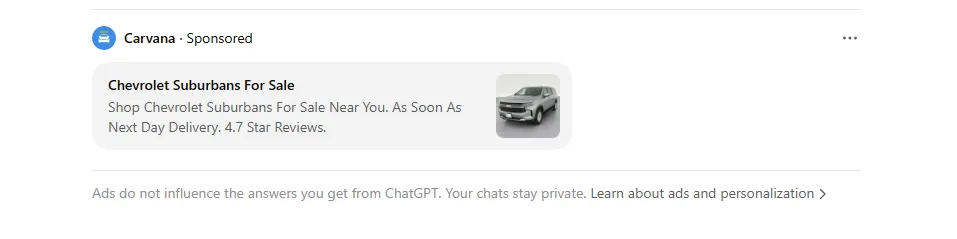
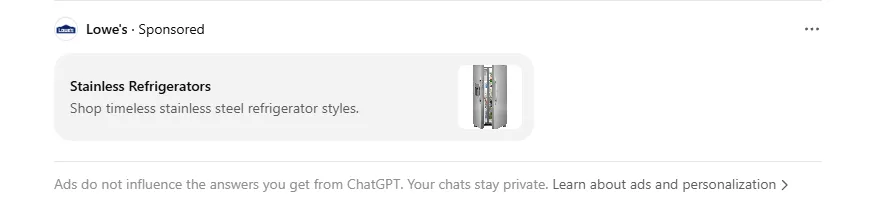
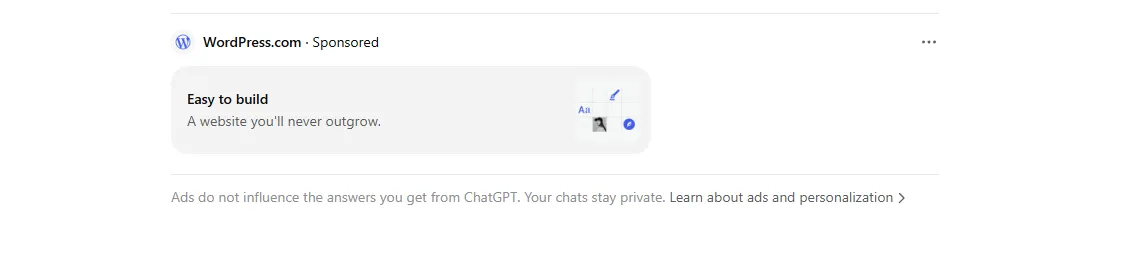
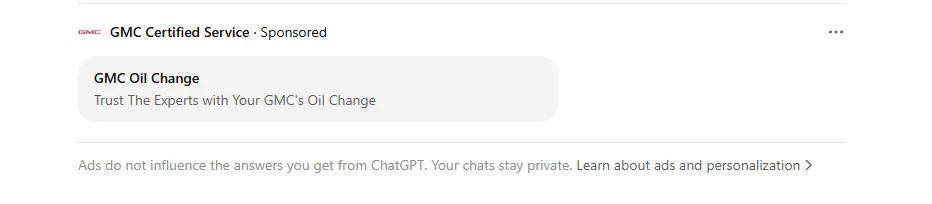
Notice the disclaimer at the bottom of each ad: "Ads do not influence the answers you get from ChatGPT." OpenAI is keeping ads clearly labeled and separate from the AI's responses.
The Numbers So Far
The ad pilot has been running since February 2026. Here's what we know from the data that's been published:
About That 0.91% Click-Through Rate
Let's talk about it. A 0.91% CTR is low compared to Google Search ads, which average around 6-7% depending on the industry.
If you looked at that number in isolation, you might write off the channel entirely. But context matters.
This is a brand new ad platform that has been live for less than two months. OpenAI is still figuring out where to place ads, how to size them, and how to make them relevant to the conversation.
Fewer than 20% of eligible users see an ad on any given day. The platform is immature, and OpenAI is actively iterating on placement and format to improve that number.
Here's what's more interesting: Criteo's data (reported by CNBC) shows that users who arrive at a website from an AI conversation convert at 1.5x the rate of users from other channels.
People using ChatGPT are in research mode. They're asking detailed questions, comparing options, and thinking through decisions. When they do click, they're further along in the buying process.
How ChatGPT Ads Compare to Other Channels
Here's how the channel stacks up against the platforms most local businesses are already using. If you want to run the numbers for your own business, try our Marketing ROI Calculator.
| Channel | Avg Cost | CTR | Best For | Maturity |
|---|---|---|---|---|
| ChatGPT Ads | $60 CPM | 0.91% | Research-phase buyers | Early stage |
| Google Search Ads | $2-8 CPC | 6-7% | Ready-to-buy customers | Mature |
| Google LSA | $20-80/lead | Varies | Licensed trades | Mature |
| Yelp Ads | $1-5 CPC | 1-3% | Review-driven buyers | Mature |
| Facebook/Meta Ads | $5-15 CPM | 0.9-1.5% | Brand awareness, retargeting | Mature |
| Bing/Microsoft Ads | $1-4 CPC | 2-3% | Lower-competition search | Mature |
The thing to notice here is not that ChatGPT's CTR is lower than Google Search. Of course it is. Google catches people at the moment they're ready to act.
ChatGPT catches people earlier, when they're still researching and forming opinions. These are different stages of the buying process, and smart businesses advertise across both.
Why Early Adopters Have an Advantage
We've seen this play out before. Google Ads launched in 2000. The businesses that figured it out early paid pennies per click while their competitors were still buying Yellow Pages ads.
Facebook Ads went self-serve in 2007. Early movers built massive audiences before the platform got crowded and expensive.
The same pattern is just starting with ChatGPT ads. Until last month, the pilot was limited to large advertisers with $200K minimum commitments. As of May 2026, applications are open to local businesses at ads.openai.com.
That means the first local businesses to get verified and run campaigns will set the benchmarks before everyone else catches on and drives costs up.
I don't know how long that window stays open. With Google, it took years. With Facebook, it was a few years. With ChatGPT, it could be shorter because businesses are more aware of new ad platforms now than they were in 2000 or 2007. But the window is open right now, and that's what matters.
What ChatGPT Ads Don't Replace
I want to be clear about this: ChatGPT ads are not a replacement for Google. They serve a different purpose.
When someone searches "plumber near me" on Google, they have a broken pipe and they need help now. That's a ready-to-buy customer. Google Search ads and Local Service Ads are built for that moment.
When someone asks ChatGPT "what should I look for in a good plumber" or "how much does it cost to repipe a house in Sacramento," they're earlier in the process. They're researching. They're forming opinions about who to call.
Getting your business in front of them at that stage is valuable, because you're the first name they see before they ever open Google.
How to Apply for ChatGPT Ads (May 2026 Update)
The application is live at ads.openai.com. It takes a few minutes.
Here's what you'll need on hand before you start:
- Legal business name
- Business type (industry / category)
- Tax ID (EIN for most US businesses)
- Business address
- Website URL
- Billing contact info
Once you submit, OpenAI puts your application into a verification queue. The confirmation screen looks like this:
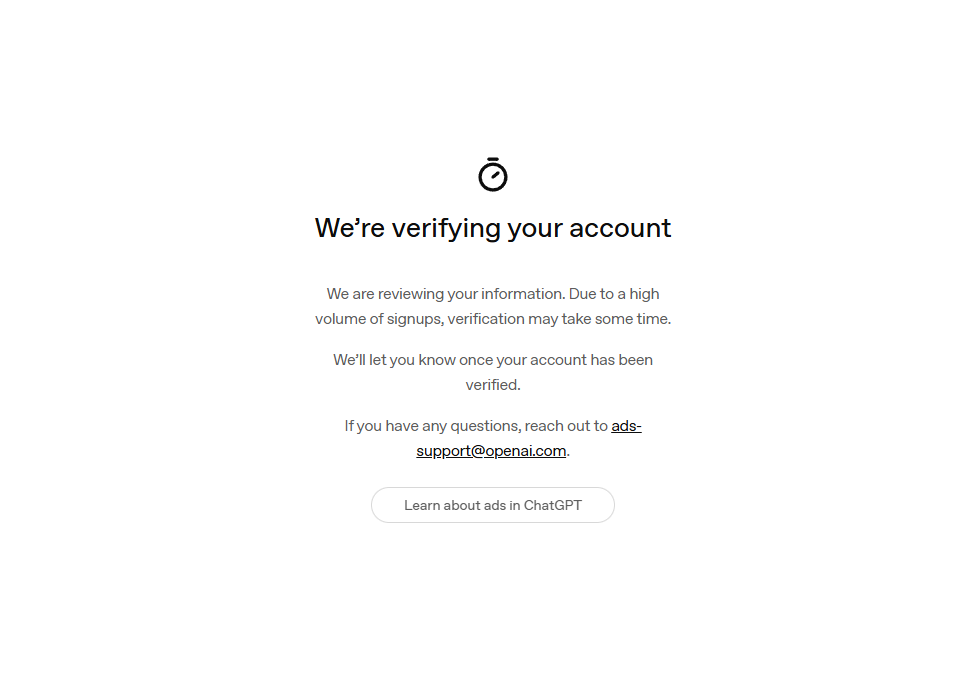
OpenAI is reviewing applications manually right now. The screen literally says "Due to a high volume of signups, verification may take some time." That's actually a good signal — it means demand is real and the early-adopter window is narrowing.
A few things to know while you wait:
- There's no fee to apply. Verification is free. You only pay when you actually run campaigns.
- Questions go to [email protected]. OpenAI replies from that address if they need anything else from you.
- Use your real legal entity. Tax ID, business name, and address need to match what's on file with the IRS / your state. Mismatches slow down review.
- Make sure your website looks legitimate. If your site is thin, broken, or missing basic trust signals (contact info, privacy policy, real content), expect a slower review. AI search optimization work pays off here.
What I'm Telling Our Clients
We're already having conversations with our clients about ChatGPT ads and what they mean for their businesses. You can see how we approach marketing channels in our case studies. Here's my honest take:
- 1. Don't rush to spend money on day one. Self-serve is launching, but the platform is still early. Watch the first round of results before committing serious budget.
- 2. Prepare your website now. Make sure your site has strong content, proper schema markup, and clear answers to the questions your customers are asking. This is what we call AI search optimization, and it pays off whether or not you run ChatGPT ads, because it also helps you show up in Google's AI Overviews and other AI-powered search tools.
- 3. Plan to test early. When the self-serve platform opens and pricing makes sense for your budget, a small test campaign will tell you more than any article can. The businesses that test early will learn what works in their market before their competitors even know the channel exists.
- 4. Don't pull budget from Google to fund this. ChatGPT ads are additive. They reach a different part of the customer journey. Keep your Google campaigns running and treat this as a new layer, not a replacement.
If you haven't applied yet, get in the verification queue now at ads.openai.com. It's free, takes a few minutes, and the sooner your account is verified the sooner you can run your first test campaign.
Want to Talk About This?
I'm watching this channel closely and helping our clients prepare. If you want to have a conversation about what ChatGPT ads could look like for your business, give me a call.
Call (916) 251-1321Wesley Cable, PipelineOS Founder

Written by
Wesley CableFounder & Lead Strategist, PipelineOS
Helping local businesses in the Sacramento region turn their online presence into measurable revenue. Specializing in local SEO, AI search optimization, and lead pipeline systems built on real data.
Connect on LinkedIn